
Dr Stephanie Brown & Dr Sanaz Hosseini | Department of Psychiatry, University of Cambridge
Study Purpose & Eligibility
What is the main goal of this University of Cambridge study on hunger and satiety (fullness) in the brain? How might this research contribute to the development of new medicines in the future?
In PWS, the brain’s tiny appetite control centre (the hypothalamus) is smaller and wired differently, meaning fullness signals from the stomach do not register in the usual way. In this study, we compare safe, high-resolution brain scans and blood gut hormones when a person is hungry (fasted) versus when they have eaten normally (fed). Animal studies in a lab cannot replicate human PWS: clinical research with families is essential to give us an objective “biological fingerprint” of hunger in the brain, helping clinical trials succeed and bringing effective, targeted medications closer for people with PWS in the UK.
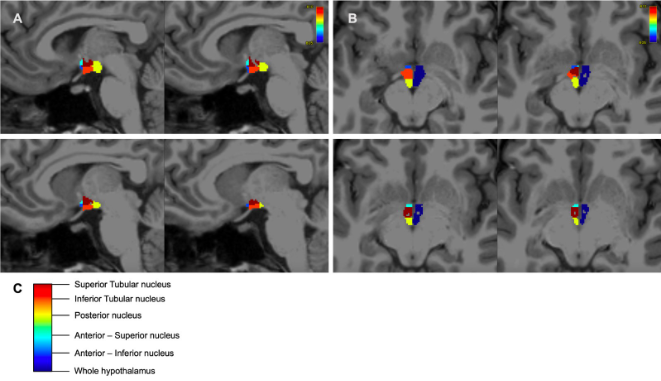
High-precision MRI mapping of the brain’s appetite control centre (the hypothalamus) and its five sub-regions at the University of Cambridge.
Who can take part? Does the participant need to be strictly between 18 and 40 years old? Why this age range?
We invite adults with PWS aged 18 to 40 (up until their 41st birthday) who have no metal implants in their body. Because the brain naturally changes across the lifespan, our NHS ethics approval strictly uses this age range so we can be confident the brain signals we measure relate to PWS rather than age.
Can individuals participate if they are non-verbal, have high anxiety, or require significant behavioural support? – and if they can, how would you and their caregivers be able to support them?
Participation is completely voluntary and must always be a positive experience, so participants do need to be able to understand what the visit involves and give their own informed consent (and if routine changes cause severe anxiety, we would never want to cause distress). For those keen to take part, our warm, experienced team goes entirely at their pace with plenty of breaks. Our participants so far have loved the one-to-one attention and leave feeling hugely proud of contributing to PWS research!
What if the individual lives in a residential care facility—how are consent, scheduling, and staff accompaniment handled?
We very warmly welcome participants living in residential or supported settings and liaise directly with their support team to schedule the visit. The participant gives their own informed consent, and a familiar support worker or family member accompanies them on the day.
Location, Travel & Overnight Stays
Where will the study visits take place (e.g., Addenbrooke’s Hospital / Cambridge University Hospitals)?
Visits take place at the Addenbrooke’s Hospital campus in Cambridge, across two specialist research centres just a few minutes’ walk apart: the Wolfson Brain Imaging Centre (WBIC) for the MRI scan, and the Cambridge Clinical Research Centre (CCRC) for the meal, blood test, and questionnaires.
How many total visits to Cambridge are involved, and over what timeframe?
There are two visits in total (one Fasted and one Fed), scheduled at least one week apart on dates that suit you. Each visit takes around 3 hours, though we book a 4-hour window so the day is never rushed.
Are travel expenses (trains, fuel, parking, taxi fares) fully covered or reimbursed?
Yes, 100%. We can either book travel in advance or reimburse all train, fuel, parking, and taxi costs for both the participant and their parent/carer, plus we provide thank you gift vouchers.
If we live far away, will overnight hotel accommodation be provided and paid for in advance for both the participant and a parent/carer?
Yes. We are very happy to arrange and pay in advance for overnight hotel accommodation for both the participant and their parent or carer.
Can a parent, family member, or residential care worker remain with the participant throughout the entire visit?
Yes, definitely. We love having parents or carers stay throughout (and ask you to complete a few carer questionnaires while with us). The only place a carer cannot stay inside is the MRI scanner room itself while the scan is running, when you are welcome to relax in the waiting room right outside or pop out for a coffee.
Fasting, Meals & Appetite Tests
The flyer mentions visits after fasting and after eating normally—how long is the required fast, and how will this be managed safely given PWS-related hunger and anxiety if food is outside of their normal times?
On the Fasted visit only, we ask the participant not to eat food from 8:00 pm the night before, though low-calorie drinks (water, no-added-sugar squash, or tea with a splash of milk) are allowed to keep them comfortable and hydrated. As soon as the morning scan and blood test finish, their lunch is served right away. Because participants are reassured and kept busy by the team, they handle the morning brilliantly and feel very proud afterwards.
What does the set meal consist of, and how are specific dietary preferences, textures, or allergies handled?
Our standard meal is a nutritionist-designed pesto pasta dish, and we always check for any allergies, intolerances, or dietary preferences in advance so our kitchen can tailor it.
Will there be snacks or extra meals provided after the fasting procedures are complete?
The set lunch is designed to break the fast comfortably, and we keep extra snacks out of sight so the clinic stays food-secure. However, if a carer or parent feels an extra snack is needed after all study assessments are finished, please feel free to bring some along.
How are food-seeking behaviours managed in the research environment to ensure the participant feels secure and calm?
The Clinical Research Centre is a strict food-neutral environment: meals are served in a private room, nobody eats or drinks in the corridors, and we can use quiet routes between buildings that completely avoid the hospital food concourse.
MRI Scans, Blood Tests & Procedures
The study involves MRI scans, blood tests, behavioural tests, and questionnaires—what does a typical visit day look like step-by-step?
1. Welcome & Consent: We chat through the day at an easy pace and sign the consent form.
2. MRI Brain Scan (WBIC): After a safety check to make sure you have no metal on you, you relax in the scanner (watching YouTube or napping for the first part, and later looking at some pictures on a screen).
3. Health Checks & Lunch (CCRC): A friendly NHS research nurse checks blood pressure, does a quick, painless heart-rate trace (ECG) and a small blood test, and then serves the set meal while we complete questionnaires.
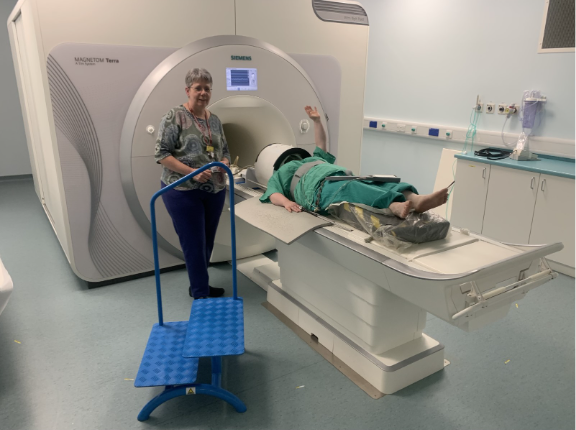
Our friendly team and the research MRI scanner at the Wolfson Brain Imaging Centre (WBIC) in Cambridge.
How long does the MRI scan take, and what happens if the participant is scared, finds the noise overwhelming, or struggles to lie still?
The scan takes about 1 hour (with the first 40 minutes or so being the quietest and most important). We provide earplugs and padded headphones for the scanner’s tapping noises and check in regularly over the intercom; if the participant feels uncomfortable or wants to stop at any point, we end the scan immediately.
Will there be a mock (practice) MRI scanner to help participants practice beforehand? or can they ‘try it out’ eg lying down in it beforehand to get comfortable with it?
While we do not have a mock scanner, we take plenty of time in the scanner room beforehand so the participant can sit on the bed, see how it works, and get comfortable at their own pace without ever being rushed. You are also most welcome to come to Cambridge to have a look at the scanner before taking part in the study.
How many blood samples will be taken, and can numbing cream (e.g., EMLA) or extra support be provided for needle anxiety?
Only one small blood draw is taken per visit by experienced, gentle NHS nurses, with the carer and researcher in the room for support. Numbing cream or spray is available on request, alongside sensory distraction gadgets, books, and puzzles.
Can procedures be paused, broken up, or skipped if a participant gets too distressed?
Yes, completely. We can pause for a break, skip a specific step, or stop the visit altogether at any time.
Will participants or families get to see or keep a picture of their brain MRI afterwards?
Yes! Simply let us know on the day and we will gladly send you a picture of your brain scan to keep.
Next Steps & Contact
How do we express interest or sign up?
Simply email Dr Stephanie Brown (sb2403@medschl.cam.ac.uk). Even if your loved one is outside the 18 to 40 age range or has metal implants, feel free to get in touch if you would like to hear about future Cambridge PWS studies.
What happens after we send an email to register interest?
We will email you our information sheet and a short MRI safety checklist, and arrange a friendly phone or video call to talk through the visits and answer your questions before booking dates that suit you.
Can a participant withdraw from the study at any point if they change their mind?
Yes, at any time, whether before, during, or between visits, without ever needing to give a reason.