We were delighted when parent and GP Dr Catriona Moore offered to visit University of Bristol recently to see first-hand how research funding is being put to work and to share her experience with our community.
Firstly, an introduction, my name is Catriona Moore, I am parent to Robin aged 3 who has PWS. I also work as a GP. As many parents do, I follow FPWR and FPWR UK research very closely and recently noticed some funding had been given to a lab at Bristol Medical School, which is on my home patch.
On behalf of FPWR UK I thought I would go and check out their work so we can give people an update of how some of the money fundraised is used.
On a sunny Tuesday morning I drove into bustling Bristol to go and meet with Professor Daniel Whitcombe at the University of Bristol. Professor Whitcombe and his team of PhD students received a grant from FPWR in 2025 to look at if neuromodulation might help to manipulate the ‘appetite’ centres in the hypothalamus area of the brain. (Neuromodulation is about changing how the brain or nerves send messages).
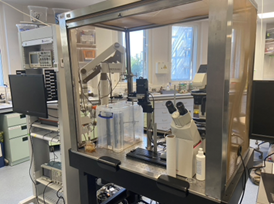
This approach is relatively new. It has been developed for the use clinically for people with a tremor. Patient’s wear a specialised helmet which targets ultrasound waves at different areas of the brain. For people who have a tremor the aim is to damage the brain cells causing it. In this context for PWS however, the plan was to use less powerful ultrasound waves to see if you can stimulate different cells in the brain but not damage them.
So far in preliminary studies have shown that this is possible. The ultrasound waves can stimulate the cells to be more active and that there is a sustained but not permanent effect.
So, what could this mean for PWS?
This study is looking at targeting the cells in an area of the back of the brain, called the hypothalamus in rats. They are going to target the cells that are responsible for releasing a hormone called BDNF, which is a key chemical involved in appetite regulation.
Prof Whitcombe was able to show me the equipment they will use to do this and how they plan to study the rats’ behaviour.
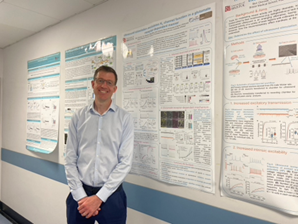
I was able to share with him some of the other difficulties people with PWS face which impacts their day to day function such as lack of thirst, poor temperature regulation and sleep disorders, which will all help to inform their research results.
I also discussed with him about the new PWS Multidisciplinary Team clinic which has been started at Bristol Children’s hospital.
The hope is to develops some interest and drive some research and clinical changes on our home turf, but also to encourage ongoing national collaboration in the PWS research field.
The study is due to start as soon as possible. So, watch this space!
Thank you for showing us round!
A huge thank you to Catriona for taking the time to visit the laboratory and share this fascinating insight into the research taking place at the University of Bristol. We would also like to thank Professor Daniel Whitcomb and his team for their warm welcome, their dedication to advancing our understanding of PWS, and for helping us bring this important work closer to the families we serve.
Most importantly, research like this is only possible because of the generosity, hard work and commitment of amazing fundraisers, supporters and donors. Every challenge, event and donation helps make projects like this a reality and brings us one step closer to better treatments for people with PWS.
To learn more about this exciting research please see Boosting Brain Signals to Help Regulate Appetite in PWS – Foundation for Prader Willi Research and Non-invasive stimulation of BDNF production in the hypothalamus to regulate satiety signalling