Please note this research (Efficacy and safety of semaglutide for obesity and hyperphagia in adults with Prader-Willi syndrome | medRxiv) is currently a preprint, which means it has not yet been peer-reviewed by independent experts.
One of the most difficult aspects of living with Prader-Willi syndrome (PWS) is hyperphagia – the intense, persistent feeling of hunger that can lead to food-seeking behaviours and severe obesity. Families often have to maintain strict supervision of food access throughout a person’s life.
In recent years, medications known as GLP-1 receptor agonists, including semaglutide (sold under brand names such as Wegovy and Ozempic), have transformed obesity treatment for many people without PWS. However, very little research has examined whether these medicines can help people with Prader-Willi syndrome.
A new study from researchers at Imperial College London and associated NHS hospitals has begun to explore this question.
What Did the Researchers Do?
The team reviewed the medical records of 12 adults with Prader-Willi syndrome who had overweight or obesity and were treated with semaglutide at a specialist UK clinic. Participants were monitored for a median of around 17 months, with most receiving weekly doses of up to 2.4 mg.
The group had significant weight-related challenges before treatment:
- Average age was 28 years.
- Most participants were female.
- Average BMI was 46.6 kg/m² (average adult healthy range is 18.5 kg/m2 to 24.9 kg/m2)
- Three-quarters of participants also had type 2 diabetes.
Did Semaglutide Reduce Weight?
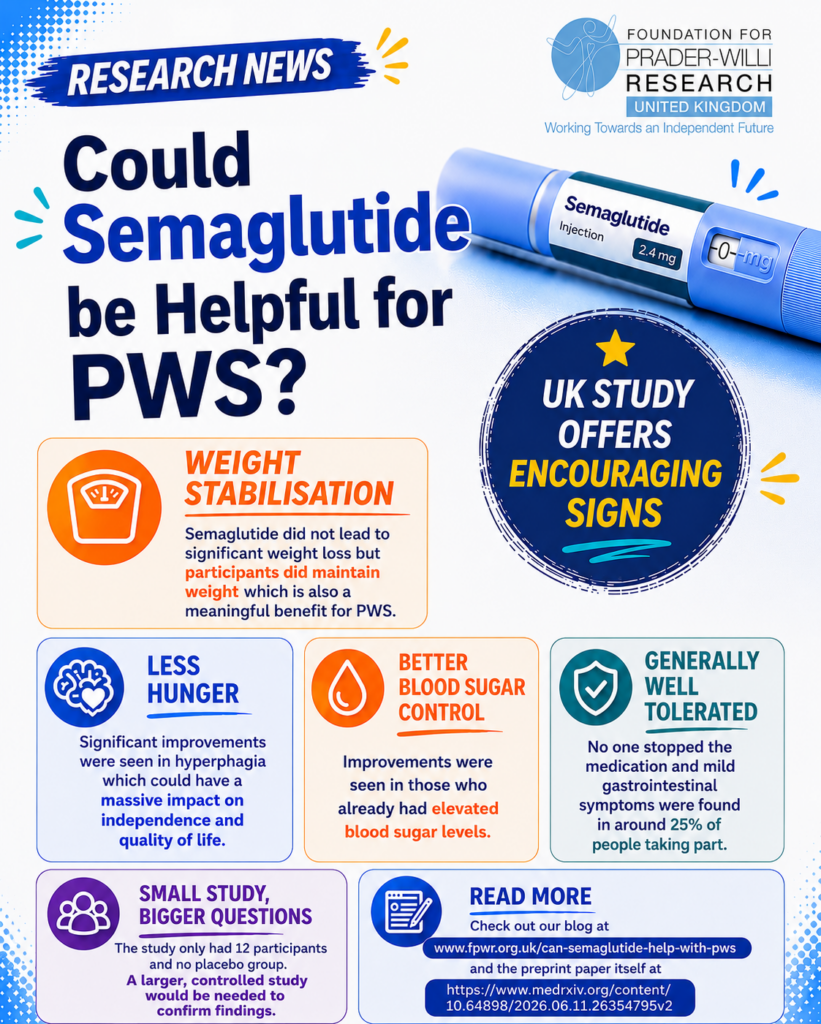
The headline result may surprise some people – Researchers did not find significant weight loss overall. However, they observed something that may still be very important: weight gain appeared to stop. Before starting semaglutide, participants had been steadily gaining weight. After treatment, their weight was generally maintained rather than continuing to increase.
For people with PWS, preventing ongoing weight gain can be an enormous challenge, so stabilising weight may represent a meaningful clinical benefit.
The Most Encouraging Finding
Perhaps the most exciting result was the improvement in hyperphagia.
Using a recognised questionnaire designed for PWS clinical trials, researchers found a significant reduction in hunger-related symptoms after participants started semaglutide. Before treatment, hyperphagia scores had remained largely unchanged, but after treatment they improved substantially.
For families affected by PWS, this finding could be particularly important. Hyperphagia is often described as having a greater impact on daily life than weight alone. Reduced food preoccupation could potentially improve quality of life, independence, emotional wellbeing, and family relationships. While this study was small, the findings suggest semaglutide may help address one of the core challenges of PWS.
What About Diabetes?
The researchers also looked at blood sugar control.
Among participants who started the study with elevated blood sugar levels, measures of long-term glucose control improved during treatment. This suggests semaglutide may provide additional benefits for people with PWS who also have type 2 diabetes.
Was It Safe?
Semaglutide was generally well tolerated.
About 25% of participants experienced mild gastrointestinal side effects, such as nausea or digestive discomfort. Importantly, no one stopped taking the medication because of side effects.
What Are the Limitations?
While the results are encouraging, there are several reasons to be cautious:
- Only 12 people were included.
- There was no placebo group for comparison.
- The study looked back at existing records rather than conducting a controlled clinical trial.
- Most participants had type 2 diabetes, so the results may not fully reflect outcomes in the wider PWS population.
The researchers themselves emphasise that larger, placebo-controlled studies are needed to confirm whether semaglutide truly reduces hyperphagia and helps with weight management in both adults and adolescents with PWS.
What does this mean for the PWS Community?
This study offers encouraging early evidence that semaglutide may have the potential to help reduce hunger, limit further weight gain, and improve blood sugar control in some people with Prader-Willi syndrome (PWS). For families affected by PWS, this is hopeful news because it suggests that an existing medication may be worth exploring further as a possible treatment option.
However, it is important to be cautious when interpreting these findings. The study involved a relatively small number of participants and did not include a placebo group for comparison. While the results are promising, they do not yet prove that semaglutide is safe and effective for people with PWS. The researchers themselves emphasise that larger, carefully designed clinical trials are needed before firm conclusions can be drawn.
The positive news is not that weight-loss medications should now be used routinely in PWS. Rather, it is that researchers have identified a medicine that appears promising enough to justify further study. Finding potential new ways to address hyperphagia and weight management in PWS is an important step forward, but more evidence is needed before these treatments can be recommended with confidence.
For now, these findings offer cautious optimism and hope for the future. We look forward to seeing larger clinical trials that can tell us whether semaglutide, and similar medications, may have a place in PWS care. FPWR UK will be following this research closely as new evidence emerges.
To read the preprint in full please visit Efficacy and safety of semaglutide for obesity and hyperphagia in adults with Prader-Willi syndrome | medRxiv