We are delighted to announce the first of three fantastic research projects that FPWR UK are investing in this year.
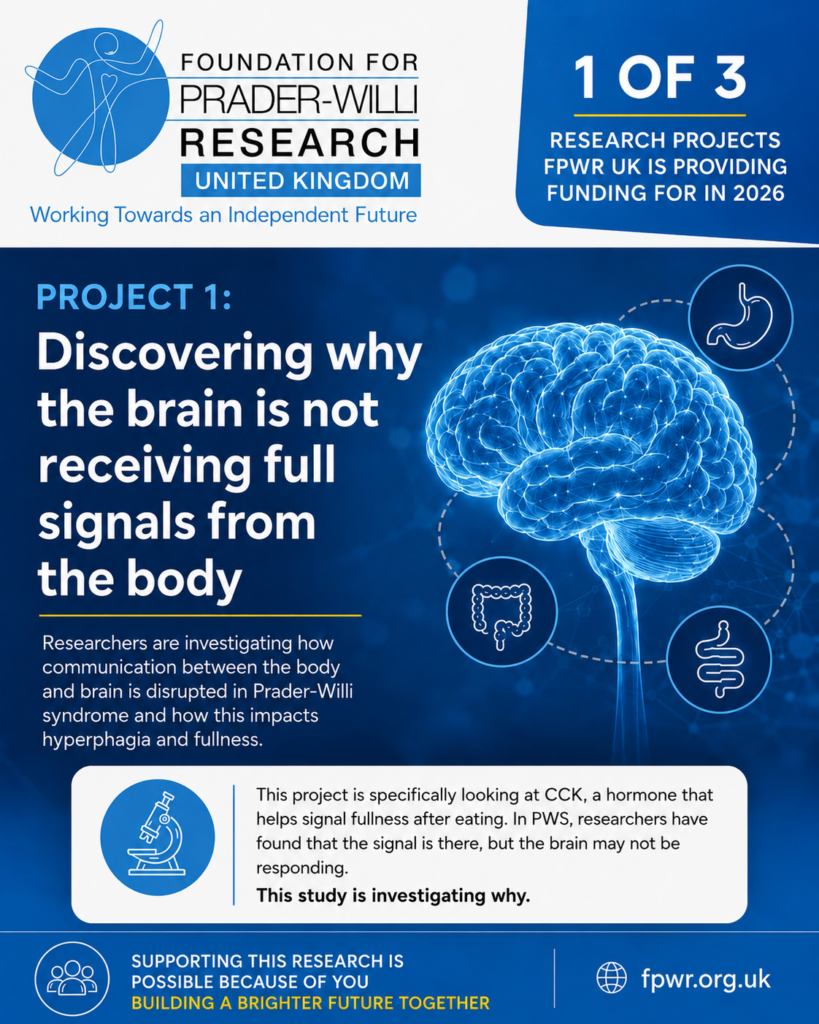
This first project, which we are excited to invest £16,000 towards, aims to better understand one of the most challenging aspects of Prader-Willi syndrome (PWS)- the lack of feeling full after eating.
The project, led by Dr Haijiang Cai, will explore why the brain appears to ignore the body’s natural “I’m full” signals in people with PWS, and whether this could lead to new treatments in the future.
Why Is This Research Important?
For many families affected by PWS, hyperphagia (an intense, persistent drive to eat) has a huge impact on daily life.
Most of us rely on a combination of hormones and brain signals to tell us when we’ve eaten enough. After a meal, our bodies release hormones that send a message to the brain saying, “You’re full now. You can stop eating.”
One of these hormones is called CCK (cholecystokinin). Surprisingly, studies have shown that people with PWS produce normal levels of CCK after they eat. In other words, the body’s “fullness signal” is being sent. The mystery is that the brain doesn’t seem to respond to it properly.
A simple way to think about it is this- the body is making the right message, but the brain isn’t receiving it like it should. Understanding why this happens could reveal entirely new ways to treat hyperphagia.
What Have Researchers Already Found?
Dr Cai’s team has previously discovered that simply giving more CCK does not reduce food intake in models of PWS. This suggests that the problem isn’t a lack of the hormone itself. Instead, something appears to be happening in the brain that prevents the message from being heard.
To investigate this further, the team uses a special mouse model that lacks a gene called Magel2, which is associated with many of the eating and metabolic difficulties seen in PWS. These mice show similar problems responding to fullness signals, making them a valuable tool for understanding the biology behind hyperphagia.
What Will This New Study Do?
The research team wants to identify exactly which parts of the brain are failing to respond to fullness signals.
Using advanced brain imaging technology, they will:
1. Search the Whole Brain
Researchers will look across the brain to find areas where fewer nerve cells (neurons) respond to CCK in the PWS mouse model.
2. Identify the Specific Brain Circuits Involved
Once those areas have been found, they will examine which neurons are not working correctly when the brain receives signals that should reduce appetite.
3. Test Whether Those Circuits Can Be Switched Back On
The team will then explore whether stimulating these specific neurons can help restore normal appetite control and reduce food intake.
What Could This Mean for People with PWS?
While this research is still at an early stage, its potential is exciting.
If scientists can identify the exact brain pathways that are not responding to fullness signals, they may be able to develop treatments that target those pathways directly. Rather than focusing on the stomach or hunger hormones themselves, future therapies could help the brain respond appropriately to signals that are already being produced by the body.
The ultimate goal is to discover new targets where medicines can be developed/utilised to help e.g. specific brain cells or circuits they could act upon, to help people with PWS achieve better appetite control and improve quality of life.
Why FPWR UK Is Proud to Support This Work
At FPWR UK, we are committed to supporting research that has the potential to make a meaningful difference to the lives of people with PWS and their families.
This project tackles one of the fundamental questions in PWS research- Why doesn’t the brain recognise that the body is full?
By helping researchers uncover the answer, we move one step closer to new treatments that could reduce the burden of hyperphagia and improve everyday life for individuals living with PWS.
We are proud to contribute towards this important work and look forward to following Dr Cai’s progress in the years ahead.
FPWR UK is proud to support this 2026 research project in partnership with the Foundation for Prader-Willi Research, helping advance scientific understanding of appetite regulation and hyperphagia in Prader-Willi syndrome.