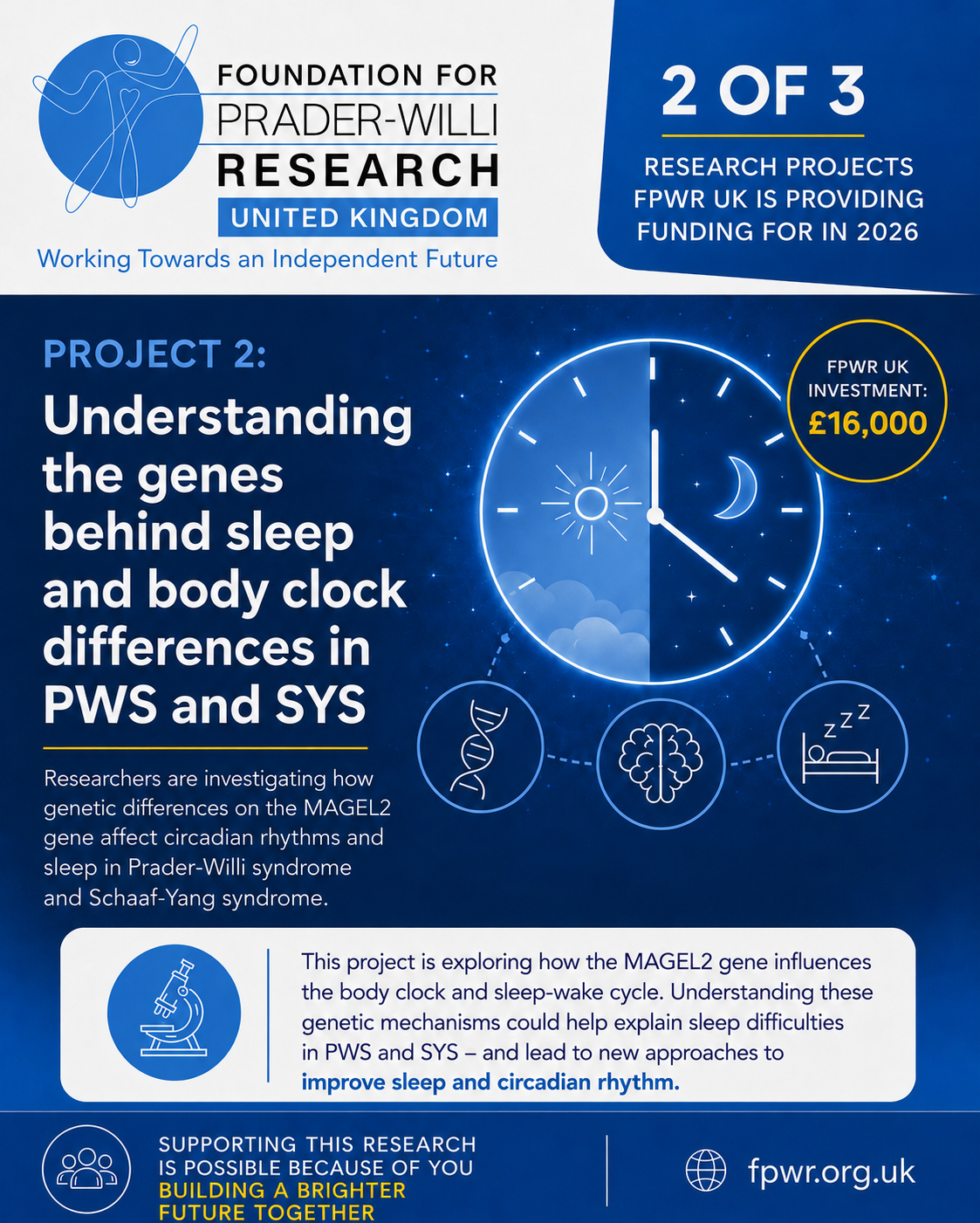
Sleep challenges are something many families living with Prader-Willi syndrome (PWS) and Schaaf-Yang syndrome (SYS) know all too well. Whether it’s disrupted nights, early waking, difficulty settling to sleep, or overwhelming daytime sleepiness, these issues can affect not only the individual but the entire family.
That’s why FPWR UK is proud to support an important research project in collaboration with FPWR USA. We are contributing £16,000 towards research led by Dr Andrew Liu, that aims to better understand why sleep problems occur in both PWS and SYS and ultimately, how they may be improved in the future.
Why is sleep so difficult in PWS and SYS?
Sleep difficulties are very common in both PWS and SYS. Families often report:
- Frequent night waking
- Difficulty settling or staying asleep
- Excessive daytime sleepiness
- Irregular sleep-wake patterns
These challenges are linked to the way the brain controls sleep and daily rhythms. At the centre of this is the circadian rhythm – our body’s internal clock that helps regulate when we feel awake and when we feel sleepy.
In both PWS and SYS, this internal clock does not function in the typical way, which can lead to ongoing sleep disruption and daytime difficulties.
The shared link: the MAGEL2 gene
A major reason PWS and SYS share similar sleep challenges is that both conditions involve a gene called MAGEL2.
- In PWS, the MAGEL2 gene is missing or inactive as part of a larger genetic change.
- In SYS, there is a specific mutation in the MAGEL2 gene.
This gene plays an important role in the hypothalamus, the part of the brain responsible for regulating sleep, hormones, appetite, and daily biological rhythms. Scientists believe that when MAGEL2 is not functioning correctly, as seen in both PWS and SYS, the body’s ability to regulate sleep and daily cycles becomes disrupted.
What is this new study about?
This FPWR-funded research project focuses on both Prader-Willi syndrome and Schaaf-Yang syndrome, recognising the strong biological connection between them.
Researchers are using specially developed mouse models that closely mimic:
- The genetic changes seen in PWS
- The specific MAGEL2 mutation seen in SYS
This allows scientists to study both conditions side by side and gain a deeper understanding of the underlying biology.
The study will:
- Examine how MAGEL2 affects sleep and circadian rhythms in both PWS and SYS
- Track sleep patterns, activity levels, and biological rhythms
- Explore how the brain’s internal “sleep clock” functions in these conditions
Researchers are essentially asking What is happening inside the body that causes sleep problems in PWS and SYS, and how can we address it?
Why use mouse models?
Mouse models are an essential part of this research because they allow scientists to study the whole body in ways that are not possible in people.
They help researchers to:
- Observe sleep patterns in detail
- Study how the brain and body interact over time
- Test ideas that could lead to future treatments for both PWS and SYS
Earlier research has already shown that when MAGEL2 is disrupted, sleep patterns and daily rhythms become irregular, mirroring the experiences reported by many families affected by PWS and SYS.
What could this mean for families living with PWS and SYS?
By improving our understanding of sleep in both PWS and SYS, scientists hope to:
- Identify targets for future medications
- Develop ways to improve sleep quality
- Reduce excessive daytime sleepiness
Better sleep could have far-reaching benefits, including improvements in:
- Behaviour and emotional regulation
- Learning and attention
- Overall quality of life for individuals and families
This type of research is known as fundamental research, meaning it seeks to understand the biology underlying PWS and SYS rather than test a new medicine. Research of this nature provides the essential building blocks for future clinical trials. Every new therapy begins with researchers first understanding exactly what is happening inside the body.
Looking Ahead
FPWR UK is excited to support this important project alongside FPWR USA, helping to advance our understanding of the biological mechanisms that drive sleep difficulties in both PWS and SYS. We will be closely monitoring the findings as the research progresses and look forward to sharing updates with our community.
We are incredibly grateful to the PWS and SYS communities whose ongoing support makes projects like this possible. Through fundraising, awareness raising, and continued engagement with our work, you are helping to drive research that brings us closer to better treatments and improved quality of life for individuals and families affected by these rare conditions. Together, we are making meaningful progress towards a brighter future.
To read more please also see Allele-specific MAGEL2 mouse models to define circadian and sleep mechanisms in PWS and SYS syndromes