Living with Prader–Willi syndrome (PWS) creates a number of challenges that affects nearly every part of daily life, from constant hunger to anxiety, learning difficulties, and emotional regulation. Imagine if one treatment could target several of these challenges at once… and imagine if that treatment didn’t require surgery, injections, or anything invasive.
That’s exactly the hope behind a new research project funded by the Foundation for Prader-Willi Research (FPWR).
What’s the background?
Scientists have long known that people with PWS have unusually low levels of something called BDNF — short for Brain-Derived Neurotrophic Factor. Think of BDNF as “brain fertiliser.” It helps brain cells grow, communicate, and stay healthy. It also plays a major role in:
– regulating appetite
– supporting learning and memory
– stabilising mood and behaviour
So, boosting BDNF could help with both hyperphagia and behavioural challenges, making it a very promising therapeutic target for PWS.
However, there’s a major challenge. BDNF is a large, delicate protein, and getting it into the brain has historically required invasive brain surgery in research settings — clearly not an option for an everyday treatment. This new project aims to change that completely.
The Game-Changer: A Simple Nasal Spray
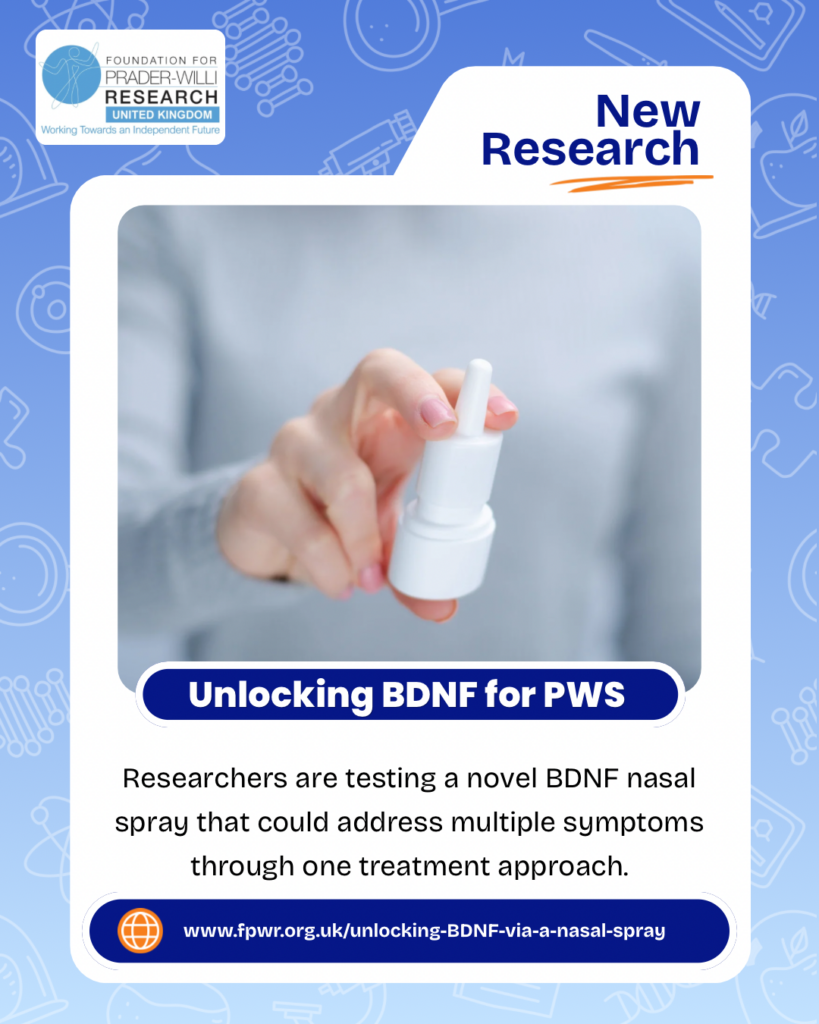
Dr. Simona Capsoni and her team are developing a non-invasive intranasal delivery system, or more simply, a BDNF nasal spray.
The nose provides a potential direct pathway to the brain. Certain molecules can travel along nerve pathways from the nasal cavity into the brain, bypassing the blood–brain barrier.
This research is still at an early stage and is currently being tested in animal models. However, if successful in further studies, it could eventually lead to an at-home treatment that supports multiple aspects of PWS.
There’s More…
Here’s where the study gets even more interesting. The team isn’t just testing BDNF alone — they’re also testing BDNF packaged inside extracellular vesicles (EVs).
EVs are tiny bubbles naturally produced by cells. They act like protective envelopes, helping delicate molecules survive the journey through the body.
In this project, EVs may help BDNF:
1. stay stable
2. reach the right brain regions
3. work more effectively at lower doses
If EVs boost BDNF’s effectiveness, the nasal spray could become even more precise and potent.
What the Researchers Are Doing Now
The project has three major steps:
1. Test the nasal spray in PWS mouse models
This will show whether BDNF can reach the brain and improve symptoms.
2. Compare BDNF alone vs. BDNF inside EVs
Which version works better? Which is safer? Which is more efficient?
3. Develop the final human-ready formula
If successful, the team will create a stable, safe nasal spray that can move toward clinical trials.
Why This Matters So Much
This research is exciting because it aims to tackle multiple PWS symptoms at once, not just hunger, not just behaviour, but the underlying brain biology that affects both.
It is also:
– Non-invasive: No surgery, no implants, no gene editing
– Potentially faster to translate: Nasal sprays are generally easier to test and develop than complex brain-targeted therapies
– Addressing root causes: Low BDNF affects appetite, mood, learning, and more
– Potentially life-changing: A single approach that could support both physical and emotional well-being
What Happens Next?
Depending on what works best in the animal studies, the team could take one of three paths:
1. If EV-packaged BDNF works best:
Move forward with the enhanced nasal spray and begin safety studies.
2. If plain BDNF works well:
Use the simpler formula and advance toward human testing.
3. If results are mixed:
Adjust the formulation or explore alternative EV carriers.
Either way, this project lays important groundwork for a future, practical treatment. To read more, visit: Precision neurotrophin intranasal delivery: BDNF meets extracellular vesicles for Prader-Willi syndrome treatment