A personal perspective from Professor Tony Holland
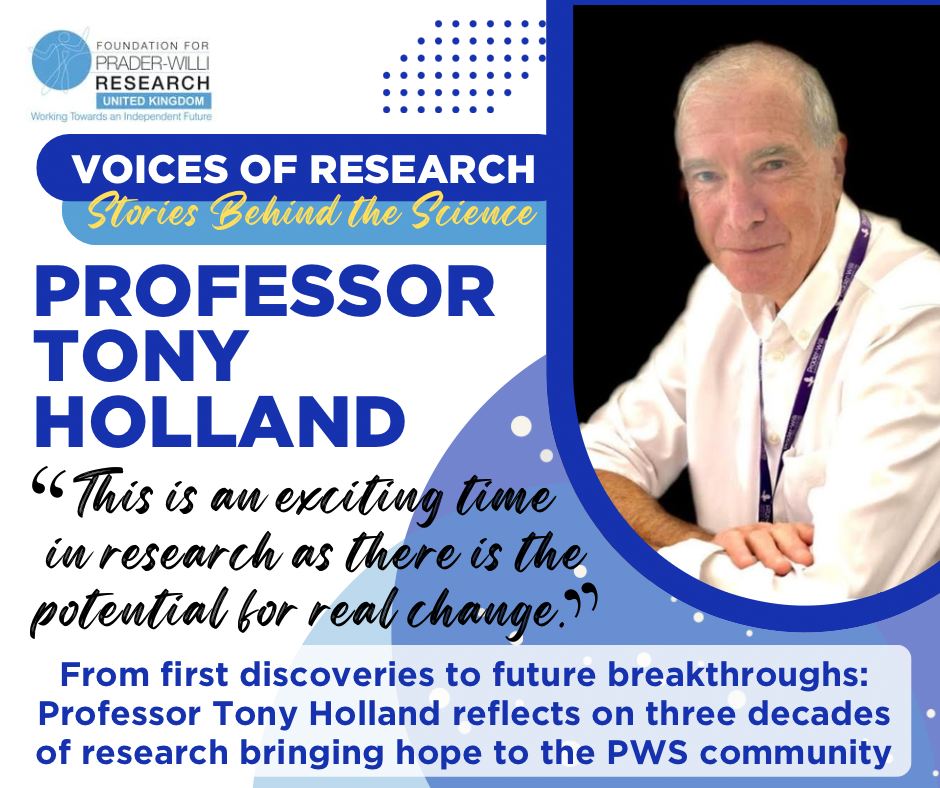
We are deeply grateful to Professor Tony Holland for sharing his reflections on over 30 years of research into Prader-Willi syndrome. Tony’s work has been instrumental in shaping our understanding of PWS—from early studies exploring hyperphagia to groundbreaking insights into brain function and mental health risks. His dedication, alongside his colleagues and the many families who have taken part in research, has paved the way for advances that bring hope for better treatments and care. We are honoured to share his personal perspective on this remarkable journey.
How did you first become involved with Prader-Willi Syndrome?
My PWS clinical and research work as a psychiatrist started when I was training in psychiatry in London and I was asked to see a young adult who had PWS and who had become very severely overweight having left home to live in a hostel for people with intellectual disabilities. I do not need to tell you why she had become so over-weight! This was a different time, I knew nothing about PWS nor did many others except for those at the UK PWSA and Bernard Laurence, the paediatrician who had described PWS in the English literature in 1961, five years after Prader had written his paper in German.
Where have you conducted your PWS research, and who has been involved in your work?
My first PWS research study was in London but after that our studies have been undertaken at the University of Cambridge together with many colleagues, particularly Dr Joyce Whittington and most recently Dr Stephanie Brown. This has been very much an interdisciplinary team effort that has only been possible through the help of many people with PWS and their families and others who support them – thank you.
In this blog I want to touch on the subsequent research journey, the blind alleys, the more transformative observations, and the shift from describing the characteristics (phenotype) associated with PWS, to understanding why a particular problem such as hyperphagia occurs, to developing and evaluating novel interventions.
Can you tell us about some of your early PWS research projects?
The starting point of this journey was in London with what was known as ‘the sandwich study’. What we showed would now be no surprise – people with PWS ate many more sandwiches over one hour compared to a comparison group without PWS. For me a very important observation was that some participants with PWS did slow and eventually stop their eating and did rate themselves as feeling full but only after many more calories than those without PWS – this was an early indication that hyperphagia was potentially modifiable. Once at the University of Cambridge the first study, funded by the Wellcome Trust, was to measure and characterise the core features of the syndrome. This was led by Joyce Whittington and was undertaken throughout what was then the Anglia and Oxford Health Region with a population of 5 million. Subsequent publications in the late 1990’s and early 2000’s described the physical, behavioural, mental health and cognitive characteristics of the syndrome. These observations established the need for and the importance of knowledge for families about the syndrome and support and access to good medical and social care.
Can you explain why individuals with PWS struggle to feel full, and what research tells us about the biological mechanisms behind this?
Our first brain imaging study (funded by a very generous donation from a family) showed that in people with PWS their brains were slow to change when they ate food, from an activation pattern in their brains associated with hunger to one associated with fullness. As with the sandwich study if they ate a lot of calories, then in some cases this change in the brain and in their hunger feelings did take place but only for a short while. Researchers in the USA have a rather different perspective.
Most recently Stephanie Brown in Cambridge used brain imaging to show that the small control area in the brain – the hypothalamus – is small in people with PWS. This observation now changes our perspective – the key questions are why doesn’t the hypothalamus develop normally and can that be corrected after birth? For me these various observations are building a picture that suggests that people with PWS are rather stuck in a hunger state and that for biological reasons they are unable to fully satiate.
In two more conceptual papers we talked about ‘The paradox of PWS – a model of starvation” to make the point that people with PWS may behave in a way that any of us would if experiencing hunger. Such observations indicate the importance of managing the food environment based on your understanding of the person’s specific needs.
You also have a strong interest in the Mental Health side of PWS, can you tell us more about that?
Other studies we have undertaken have shown that people with the UPD form of PWS are more at risk, compared to those with a deletion, for mental illness. Such illnesses usually presents in the teens and early adult life with a significant change in the person’s wellbeing, mental state and behaviour that persists over time – it is important to emphasise that such an illness can be treated safely with medication. We are now using brain scanning to better understand this risk which is primarily but not exclusively in those with UPD.
Which other studies have you been involved in that you are currently excited about?
One of the most exciting other studies was the investigation of the use of vagus nerve stimulation using a medical device, a standard and approved treatment for epilepsy. In this case, however, we thought it may help the hyperphagia, but it did not, but it seemed to have a significant beneficial effect on other behaviours. Something that was also observed in a second small trial and is now being further evaluated in a large study in the USA.
Where do you see the UK’s place in PWS Research?
In partnership with many participants, our work in Cambridge has made a significant contribution to global knowledge about PWS. We are now a Centre for clinical trials in PWS and Stephanie Brown is pioneering the use of state-of-the-art brain scanning techniques to enable us to further understand these various challenges faced by people with PWS.
This is an exciting time in research as there is the potential for real change – quite when is uncertain but hopefully soon. Careful and systematic research with a little bit of serendipity, with publications peer reviewed and published for all to see is the way treatments are developed.
The global PWS community is strong with many National PWS Associations, FPWR and IPWSO and it is an international community that it is a delight to be part of.
Thank you so much to Professor Holland for your time to talk about some of the amazing projects you’ve been involved in and thank you to Professor Holland and the team at University of Cambridge for their continued commitment to the PWS Community.